
Sponsored Content
Miner Madencilik | Leading Bentonite Producer in Turkey www.miner.com.tr →
📋 Executive Summary
Sodium bentonite and calcium bentonite represent the two primary commercial classifications of bentonite clay, distinguished fundamentally by their dominant exchangeable cation. While both originate from the alteration of volcanic ash, their distinct mineralogical compositions result in dramatically different physical behaviors, swelling capacities, and industrial applications. This comprehensive analysis examines the structural, chemical, and performance characteristics of both bentonite types, providing technical specifications aligned with international standards including ASTM, API, and ISO classifications.
1. Introduction to Bentonite Clay Systems
Bentonite is a highly plastic, colloidal clay primarily composed of montmorillonite, a smectite group mineral characterized by its 2:1 layered silicate structure. The name "bentonite" originates from Fort Benton, Wyoming, USA, where the first commercial deposits were identified in the 19th century. However, significant global reserves exist, including high-quality deposits in Nevşehir, Türkiye, where Miner Madencilik operates modern extraction and processing facilities.
The classification of bentonite as either sodium or calcium type depends on the predominant exchangeable cation occupying the interlayer positions within the montmorillonite structure. This cation exchange capacity (CEC) fundamentally dictates the material's industrial utility and economic value.
2. Mineralogical and Chemical Composition
2.1 Structural Characteristics
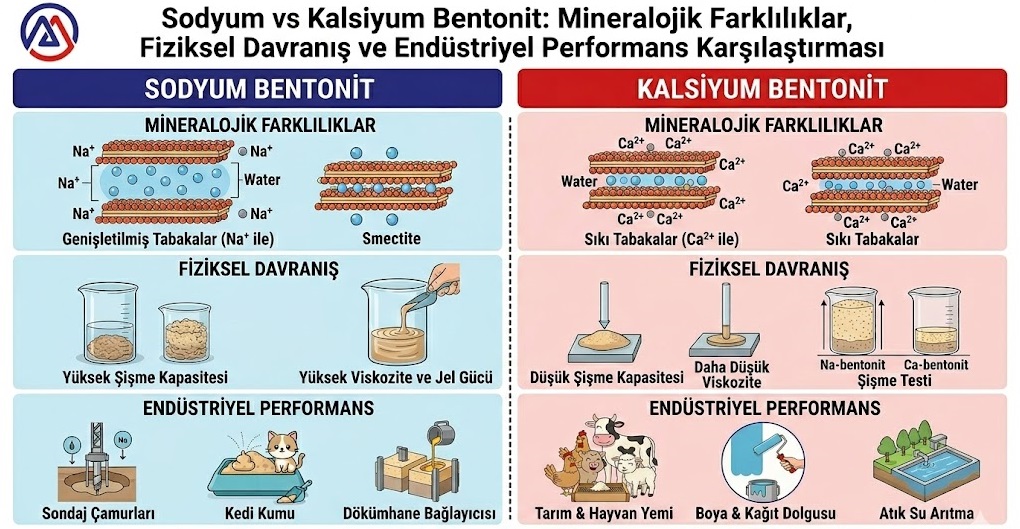
Both sodium and calcium bentonites share the fundamental smectite structure: two tetrahedral silica sheets sandwiching a central octahedral alumina sheet. However, critical differences emerge in their interlayer chemistry:
2.2 Chemical Composition Ranges
Typical oxide compositions for commercial grades (weight %):
3. Physical Properties and Behavior
- High swelling capacity (15 - 30 times dry volume)
- Forms stable, thixotropic gels at low concentrations (4 - 6% solids)
- Displays spontaneous dispersion in water without mechanical agitation
- Creates low-permeability barriers (hydraulic conductivity: 1×10⁻⁹ to 1×10⁻¹¹ m/s)
- Maintains suspension stability over extended periods
- Moderate swelling (5 - 10 times dry volume)
- Requires higher solids content (10 - 15%) for gel formation
- Needs mechanical energy (shear mixing) for optimal dispersion
- Higher permeability when hydrated (1×10⁻⁸ to 1×10⁻¹⁰ m/s)
- Tendency toward flocculation and sedimentation
3.1 Rheological Properties
Flow behavior comparison (API Standard tests):
4. Industrial Performance Comparison
🛢️ 4.1 Oil and Gas Drilling Fluids
Sodium Bentonite (API Standard)
The preferred choice for drilling mud formulations due to superior suspension properties and filtration control.
- Viscometer dial reading at 600 rpm: ≥30
- Yield point/plastic viscosity ratio: ≤3
- Filtrate volume: ≤15.0 mL
- Residue >75 μm: ≤4.0% mass fraction
Calcium Bentonite
Used in specialized applications requiring lower swelling or as a cost-effective filler.
Often activated with sodium carbonate (soda ash) to improve performance.
🏭 4.2 Foundry Applications
| Parameter | Sodium Bentonite | Calcium Bentonite |
|---|---|---|
| Green Compression Strength | High (suitable for steel casting) | Moderate (suitable for iron casting) |
| Dry Compression Strength | Excellent | Good |
| Thermal Durability | Superior | Adequate |
| Reclamation Efficiency | High | Moderate |
| Typical Addition Rate | 4 - 8% by weight | 6 - 10% by weight |
🌍 4.3 Geosynthetic Clay Liners (GCL) and Environmental Barriers
SODIUM BENTONITE IS MANDATORY for environmental containment applications
- Self-healing properties when punctured
- Extremely low hydraulic conductivity (<5×10⁻¹¹ m/s per ASTM D5887)
- High swelling pressure (50 - 150 kPa)
- Chemical resistance to leachates
⚙️ 4.4 Iron Ore Pelletizing
Sodium Bentonite
- Standard binder in pelletizing (0.5 - 1.0% addition)
- Superior dry and wet ball strength
- Higher pyroplasticity (burned bond strength)
- Lower silica contamination of pellets
Calcium Bentonite
- Requires higher addition rates (1.5 - 2.5%)
- Lower pellet strength
- Higher gangue content
- Cost advantage in some regional markets
5. Selection Criteria and Decision Matrix
| Application | Recommended Type | Key Selection Factors |
|---|---|---|
| Oil/Gas Drilling | SODIUM | API specification compliance, yield, filtration control |
| Steel Foundry | SODIUM | High thermal durability, green strength |
| Iron Foundry (Cost-sensitive) | CALCIUM / ACTIVATED | Cost/performance ratio, reclamation rate |
| Environmental Liners | SODIUM (NATURAL) | Hydraulic conductivity, self-healing, chemical resistance |
| Iron Ore Pelletizing | SODIUM | Bonding efficiency, silica content, pyroplasticity |
| Feed Binder | CALCIUM | Pellet durability, digestibility, cost |
| Construction Slurry | SODIUM | Viscosity stability, sand carrying capacity |
🇹🇷 Turkey and Nevşehir Bentonite Potential
Turkey holds a significant portion of world bentonite reserves. Particularly the deposits in the Nevşehir region possess ideal characteristics for high-quality calcium bentonite and sodium-activated bentonite production.
Miner Madencilik Advantages
Conclusion
The distinction between sodium and calcium bentonite extends far beyond simple chemical classification. Sodium bentonite's superior swelling capacity, colloidal properties, and rheological performance make it indispensable for high-value applications in drilling, environmental containment, and premium foundry operations.
For industries requiring consistent, specification-grade bentonite products, sourcing from established producers with rigorous quality control is essential. Miner Madencilik provides certified bentonite products from Nevşehir, Türkiye, meeting ASTM, API, and ISO standards for global industrial applications.
References and Standards
- American Petroleum Institute (API) Specification 13A, 18th Edition
- ASTM International Standards C324, D4380, D2196
- ISO 13500:2008 Petroleum and natural gas industries — Drilling fluid materials
- ISO 10769:2011 Clay geosynthetic barriers — Determination of fluid transmission
- Grim, R.E. & Guven, N. (1978). Bentonites: Geology, Mineralogy, Properties and Uses. Elsevier.
- Murray, H.H. (2007). Applied Clay Mineralogy. Elsevier.
Sponsor of This Technical Guide
Miner Madencilik
Leading Bentonite Producer in Nevşehir, Turkey
Specializing in high-quality calcium bentonite extraction, sodium activation processes, and custom bentonite solutions for drilling, foundry, construction, and environmental applications.