
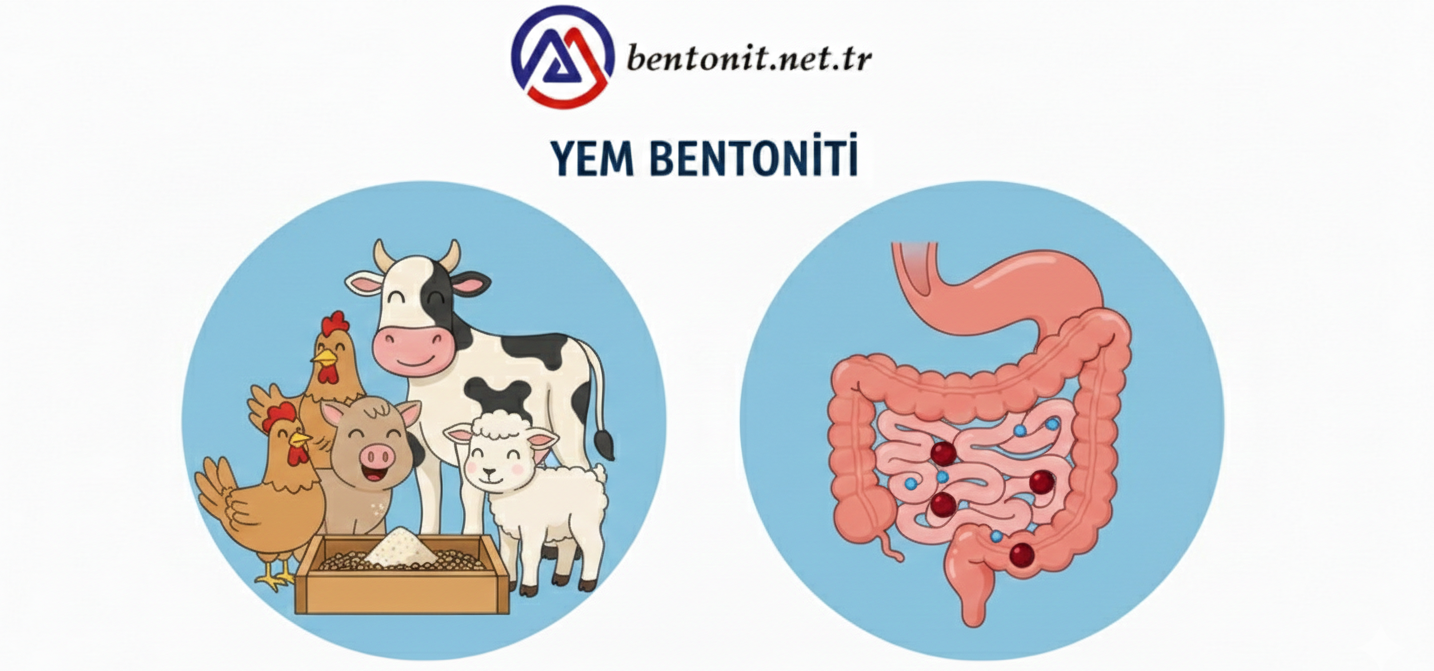
1. Mineralogical and Crystallochemical Foundation of Feed Bentonite
Bentonite used in the feed industry is a 2:1 type layered silicate clay mineral consisting mainly of montmorillonite, formed by the hydrothermal alteration of volcanic tuff. Feed grade bentonite is classified according to Cation Exchange Capacity (CEC) and adsorption properties into sodium (Na⁺) or calcium (Ca²⁺) saturated forms. Sodium bentonite exhibits higher swelling index and adsorption capacity, while calcium bentonite provides more stable structure and selective mineral adsorption.
1.1. Crystal Chemistry and Structural Properties
Montmorillonite possesses a 2:1 phyllosilicate structure where an alumina octahedral layer is sandwiched between two silica tetrahedral sheets. Isomorphous substitution in the tetrahedral sheets (Al³⁺ replaced by Mg²⁺ or Fe²⁺) creates a net negative surface charge balanced by hydrated cations in the interlayer space. The typical chemical formula of bentonite used in feed:
Typical oxide composition of feed grade quality bentonite:
1.2. Colloidal and Physical Properties
- Swelling Index: 25-35 mL/2g for sodium bentonite (minimum 20 mL/2g for feed grade)
- Cation Exchange Capacity (CEC): 70-110 meq/100g (methylene blue method)
- Specific Surface Area: 400-700 m²/g (BET method)
- Particle Size: 90% below 75 microns (200 mesh)
- pH (suspension): 8.0-10.0 (optimal for digestive system tolerance)
- Density: 2.3-2.6 g/cm³
- Zeta Potential: -20mV to -40mV (dispersion stability)
- Mycotoxin Adsorption Capacity: >95% for Aflatoxin B1 (at 1:20000 ratio)
2. Feed Quality Standards and Regulations
Feed grade bentonite is subject to international and national regulations due to its direct impact on animal and human health. Bentonite (E558) is used in the European Union as a feed additive approved by the Food and Drug Administration (FDA) and the Turkish Ministry of Agriculture.
3. Feed Bentonite Usage Decision Tree and Scenario Analysis
Bentonite selection and dosage optimization are required according to different animal species, production stages, and contamination risks. The following decision tree systematizes academic and practical applications:
4. Laboratory Test Methods and Procedures
The following standard tests are applied for feed bentonite quality control and formulation optimization:
4.1. Mycotoxin Adsorption Capacity Test (In Vitro)
Purpose: Determine the efficiency of bentonite in binding Aflatoxin B1 and other mycotoxins.
- ▸Sample Preparation: 100 mg bentonite sample mixed with 10 mL Aflatoxin B1 solution (1 µg/mL, in pH 3.0 and 7.0 buffers).
- ▸Incubation: Held at 37°C for 2 hours in shaking incubator (digestion simulation).
- ▸Centrifugation: Supernatant separated after centrifugation at 3000 rpm for 15 minutes.
- ▸HPLC Analysis: Residual aflatoxin concentration quantitatively analyzed by HPLC with fluorescence detector.
- ▸Calculation: Binding % = [(C₀ - C₁) / C₀] × 100. C₀: Initial concentration, C₁: Final concentration. Feed standard: ≥90% binding (at pH 3.0 and 7.0).
4.2. Cation Exchange Capacity (CEC) - Methylene Blue Method
Purpose: Measure the CEC value that determines bentonite's adsorption capacity.
- ▸Reagents: 0.01N Methylene blue solution, 3% Hydrogen peroxide, 1N Sulfuric acid.
- ▸Procedure: 2.00 g bentonite added to 50 mL distilled water, stirred for 5 minutes. Methylene blue added dropwise, waiting 2 minutes between drops. Tested on filter paper (halo test).
- ▸Endpoint: Continue addition until blue halo forms on filter.
- ▸Calculation: CEC (meq/100g) = (V × N × 100) / (m × 1000) × 319.85. V: Volume of methylene blue consumed (mL), N: Normality, m: Sample weight (g). Optimal for feed quality: 70-110 meq/100g.
4.3. Swelling Index Test
Purpose: Determine bentonite's water holding capacity and volume increase ability.
- ▸Sample: 2.00 ± 0.01 g bentonite dried at 105°C, passed through 75 micron sieve.
- ▸Procedure: Sample placed in 100 mL graduated cylinder, 90 mL deionized water (pH 6.8-7.2) slowly added.
- ▸Waiting: Left for 2 hours at 25±2°C, away from vibrations.
- ▸Measurement: Read the volume formed by the clay/water interface (mL/2g).
- ▸Evaluation: Feed grade Na-bentonite: ≥20 mL/2g; High quality: ≥25 mL/2g. Low swelling indicates calcium dominance or low montmorillonite content.
4.4. Heavy Metal Analysis (ICP-MS)
Purpose: Detect critical heavy metal contamination for feed safety.
- ▸Sample Preparation: 0.5 g bentonite dissolved in 10 mL HNO₃ (65%) and 2 mL H₂O₂ in microwave digestion system at 180°C.
- ▸Analysis: Analysis of Pb, Cd, As, Hg, Cr by ICP-MS (Inductively Coupled Plasma Mass Spectrometry).
- ▸Limits: Pb ≤10 mg/kg, Cd ≤0.5 mg/kg, As ≤2 mg/kg, Hg ≤0.1 mg/kg (EU 2002/32/EC).
4.5. Mineralogical Analysis (XRD - X-Ray Diffraction)
Purpose: Determine montmorillonite content and impurity minerals (quartz, calcite, feldspar).
- ▸Sample: <10 micron fraction, ethylene glycol saturated, prepared on glass slide.
- ▸Scanning: In 2-30° 2θ range, with Cu Kα radiation.
- ▸Peak Positions: Montmorillonite (001): 12-15 Å (17 Å with ethylene glycol). Quartz: 3.34 Å, Calcite: 3.03 Å.
- ▸Quantification: Montmorillonite percentage determined by Rietveld or semi-quantitative methods. ≥70% montmorillonite mandatory for feed quality.
4.6. Microbiological Analysis
Purpose: Detect contamination by pathogenic and toxigenic microorganisms.
- ▸Salmonella: Presence/absence test in 25 g sample according to ISO 6579. Must be negative.
- ▸Enterobacteriaceae: ISO 21528, ≤10³ CFU/g.
- ▸Mold and Yeast: ISO 21527, ≤10³ CFU/g. Special investigation for Aspergillus flavus presence.
5. Nutritional Physiology and Metabolic Effects
5.1. Gastrointestinal Mechanisms
Feed bentonite exhibits multiple physiological effects in the digestive tract:
- Mucosal Barrier Protection: Montmorillonite forms a protective layer on intestinal epithelial cells. Increases expression of tight junction proteins (occludin, claudin), reducing intestinal permeability.
- Adsorption Mechanism: Mycotoxin binding occurs through cation exchange and surface adsorption in montmorillonite interlamellar spaces. Van der Waals forces and hydrogen bonds form between the diphenyl system structure of Aflatoxin B1 and clay surface.
- Digesta Transit Rate: Bentonite increases digesta viscosity, slowing passage rate. This extends nutrient absorption time and improves digestive efficiency.
- Electrolyte Balance: High CEC bentonite binds excess ammonia and toxic metabolites in the intestinal lumen, preventing their entry into circulation.
5.2. Effects on Performance Parameters
According to scientific studies, feed bentonite usage affects performance as follows:
- Average Daily Weight Gain: 5-12% improvement in cattle, 3-8% in poultry (on contaminated feeds).
- Feed Conversion Ratio (FCR): 0.05-0.15 unit improvement.
- Milk Yield: 3-7% increase in dairy cows (especially during summer stress periods).
- Egg Production: 2-5% increase, 10-20% reduction in broken/cracked egg rate.
- Immune Function: Elevated serum IgG and IgA levels, decreased inflammatory cytokines (IL-6, TNF-α).
5.3. Mycotoxin Binding Selectivity
Bentonites exhibit selective adsorption of different mycotoxins:
- High Affinity: Aflatoxin B1 (>95%), Aflatoxin G1 (90-95%).
- Medium Affinity: Ochratoxin A (60-80%), T-2 Toxin (40-60%).
- Low Affinity: Zearalenone (30-50%), Fumonisin (20-40%), Deoxynivalenol (DON) (<20%).
For low affinity toxins, organic modified bentonite (HSCAS) or combination with enzymatic detoxification (esterases) is recommended.
6. Conclusion and Academic Evaluation
Feed grade bentonite, as a multifunctional additive in animal nutrition, provides scientifically proven effects on mycotoxin binding, digestive optimization, and metabolic health. High montmorillonite content (>70%), optimal CEC (80-100 meq/100g), and low heavy metal contamination are critical parameters for feed safety and performance.
Academic and industrial research shows that bentonite usage contributes significantly to animal welfare, production efficiency, and food safety (reducing residual mycotoxins). Correct bentonite selection should be made according to animal species, physiological status, and contamination risk. In this context, comprehensive quality control testing (mycotoxin adsorption, CEC, heavy metal analysis) and mineralogical characterization (XRD) are critically important applications.
References and Standards
- European Commission Regulation (EC) No 1831/2003 of the European Parliament and of the Council of 22 September 2003 on additives for use in animal nutrition.
- European Commission Directive 2002/32/EC of the European Parliament and of the Council of 7 May 2002 on undesirable substances in animal feed.
- FDA 21 CFR 582.2727 - Bentonite, Code of Federal Regulations, U.S. Food and Drug Administration.
- EFSA Journal 2011;9(2):2004, "Safety and efficacy of bentonite as a feed additive for all animal species".
- Phillips, T.D., Sarr, A.B., Grant, P.G. (1995). Selective chemisorption and detoxification of aflatoxins by phyllosilicate clay. Natural Toxins, 3(4), 204-213.
- Dixon, J.B. (1989). Kaolin and serpentine group minerals. In: Minerals in Soil Environments, Soil Science Society of America, Madison, WI, pp. 467-525.
- EFSA Panel on Additives and Products or Substances used in Animal Feed (FEEDAP). (2013). Scientific Opinion on the safety and efficacy of bentonite (dioctahedral montmorillonite) as feed additive for all animal species. EFSA Journal, 11(7), 3298.
- Vekiru, C., et al. (2007). Influence of pH on the ability of clays to bind aflatoxin B1. World Mycotoxin Journal, 1(1), 125-130.
- AOAC Official Method 2015.06 - Determination of aflatoxins in corn and peanut butter.
- ISO/TS 17796:2013 - Animal feeding stuffs — Determination of aflatoxin B1 content of feed materials and compound feed.
- Chaturvedi, V.K., et al. (2019). Bentonite as a feed supplement for livestock: A review. Journal of Animal Physiology and Animal Nutrition, 103(3), 735-745.
© 2026 bentonit.net.tr publication. All rights reserved.